
The Man Who Helped Build the Studio Tour: My Dad, in His Own Words
Every Father's Day, I post something about my dad. This year, I'm letting him do the talking.
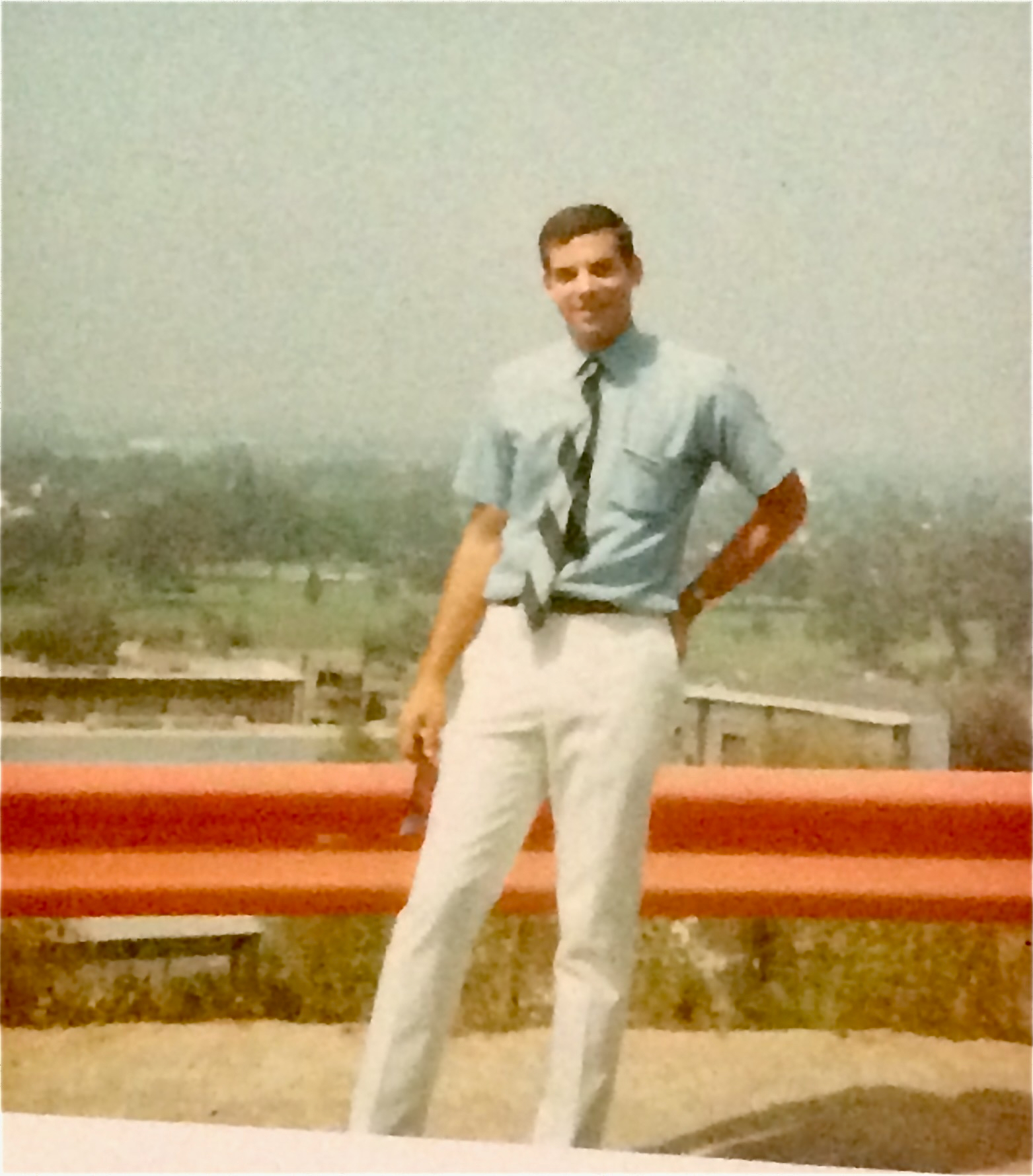
Dad as a young Universal Studios tour guide, around 1968, at the top of the hill overlooking the San Fernando Valley.
If you've followed me for a while, you know the ritual by now. Every Father's Day since my dad, Terry Winnick, passed away in 2014, I put something out into the world about him. Some years it's a photo. Some years it's a story. It's how I keep him close, and how I let the people who never got to meet him know him a little.
This year is different. This year, I don't have to tell you a story about my dad secondhand. I get to let you hear him tell it himself.
In August of 2014, not long before he passed, my dad sat down for a long phone interview. The man asking the questions was Jonathan Green, the son of my dad's best friend, Jerry Green. Both Jonathan and Jerry are contributors to Inside Universal (insideuniversal.com), and Jonathan was working on the history of Universal Studios Hollywood. There was nobody better to ask. My dad didn't just visit that place. He helped build it.
Listen to the full conversation here: From Glamor Trams to Galactica: Terry Winnick on Building Universal Studios. It's the first episode of my podcast, Ground Loop.
From the commissary lunch counter to a global theme park
If you've ever ridden the Universal Studio Tour, you've experienced something my dad spent a chunk of his life creating. He started there as a young tour guide in the late 1960s, alongside Jerry, who used to announce Ray Berwick's famous animal show, the one with the birds from Hitchcock's The Birds and Fred the cockatoo from Baretta. Dad worked his way up to running the place. For a stretch he was the Executive Vice President of the tour.
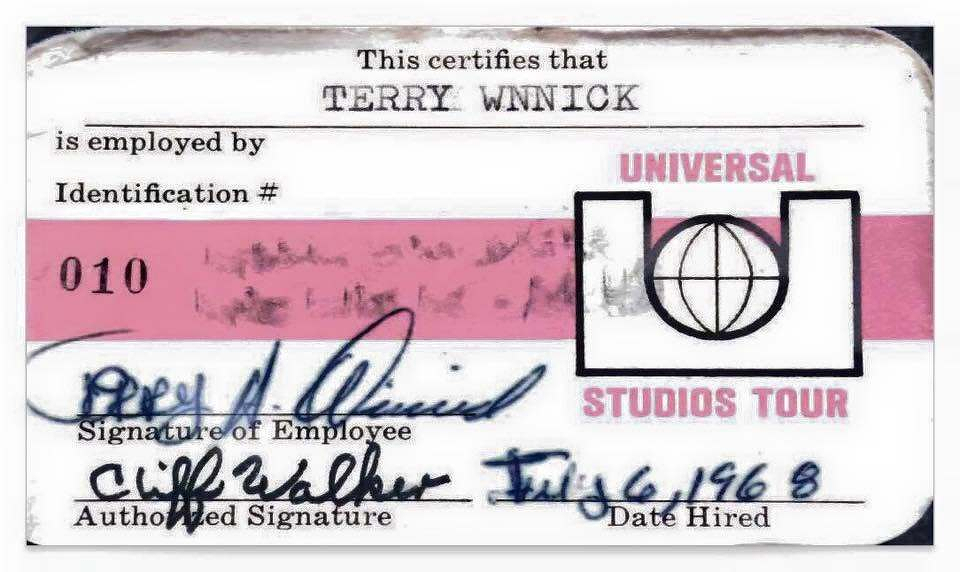
Dad's Universal Studios Tour ID. He was employee #010, hired July 6, 1968, and the card is signed by Cliff Walker, the operations manager he talks about in the interview.
In the interview, he walks Jonathan through the entire origin story, much of it pulled purely from memory. How the tour began in 1964, not as a theme park, but as a way to sell more lunches. Gray Line sightseeing buses used to pay to drive their tourists onto the lot and over to the commissary to eat. A man named Al Dorskind had the idea to take people off the buses and put them onto trams. Universal contracted a little outfit called Mini-Bus to build the first pink-and-white "Glamor Trams," and the tour was born.
He describes a version of the place almost nobody alive remembers anymore:
- The first "tour center" was just trailers and ticket booths on a freshly graded hilltop, with the old water tank still standing.
- The information desk in the lobby was a long, low counter shaped like a rowboat (the guides literally called it "the boat"), where tour guides took turns answering the phones.
- There were no back-lot attractions yet. The tram would stop and you'd walk through Men's Feature Wardrobe to see the costumes, or stand inside an empty sound stage for an hour and a half while the guide filled in the blanks. No animation, no film, no computers. None of it had been invented yet.
- The very first piece of "animation" on the back lot was a gorilla on a cable that swung between two palm trees. It was a running gag. Some mornings the crew would dress it in polka-dot shorts or hand it a bunch of bananas.
The fact that he could recall all of this, in this kind of detail, decades later, still amazes me. He says it himself near the end of the recording: "Once I start talking, then I can remember all this stuff." You can hear him doing exactly that in real time, one memory pulling up the next.
The Washington detour, and a tram through Arlington
One of my favorite stretches has nothing to do with Hollywood. Around 1970, Universal won a federal contract to run a guided tour of the National Mall and Arlington National Cemetery in Washington, D.C.: the Tourmobile. Dad moved east to become its director of operations.
He explains how it all connected: the lessons they learned running buses and trams through Arlington fed directly back into the studio tour. The "super tram" they built for the cemetery taught them how much more capacity a bigger vehicle could handle, which is why the trams back home grew from three cars to four, and eventually to the giant trams that still run today. It's the kind of throughline you'd never guess as a guest. A tour through a national cemetery quietly shaped the ride millions of people take in California.
Building the future with binary code and a garage computer
By the 1970s, my dad had become the guy who built the attractions. The Collapsing Bridge in 1974. The rebuilt Jaws. He talks about why the studio's own special-effects department couldn't keep up. They were brilliant at building something that worked once, for a single camera take. But a tour attraction has to work more than two hundred times a day, seven days a week, for years. That's a different kind of engineering, and it's where he came in.
The crown jewel of the interview is the Battle of Galactica, which opened in 1979. It was the most sophisticated thing they'd ever attempted: the first themed attraction with audio-animatronic characters outside a Disney park, and the first dark ride to combine animatronics, lasers, and live actors. He was issued the federal license for the world's first permanent laser exhibition, a piece of history that still survives today.
And here's the part that floors me every time. There were no off-the-shelf computers to run it. So the computer was hand-built in a garage by Dr. Sandor Hawley, who by day ran a laser physics lab at Rocketdyne and worked on the government's "Star Wars" laser program. At night, my dad and an electrician named John Adams would sit in a trailer parked on the construction site, burning individual chips by hand. They flipped switches in binary, 0-1-0-0-1, to make a robot's arm move up, down, left, right, then ran inside to see if it worked. If the code was off, the arm went the wrong way, and they'd burn a new chip and start over.
He built attractions like that on impossible timelines: concept in the fall, budget approved January 1st, open by June 15th when school let out. From January to June, he says, he didn't really go home. He lived in a motor home on the site and they worked around the clock. "That's why my hair's gray," he tells Jonathan. "Or white."
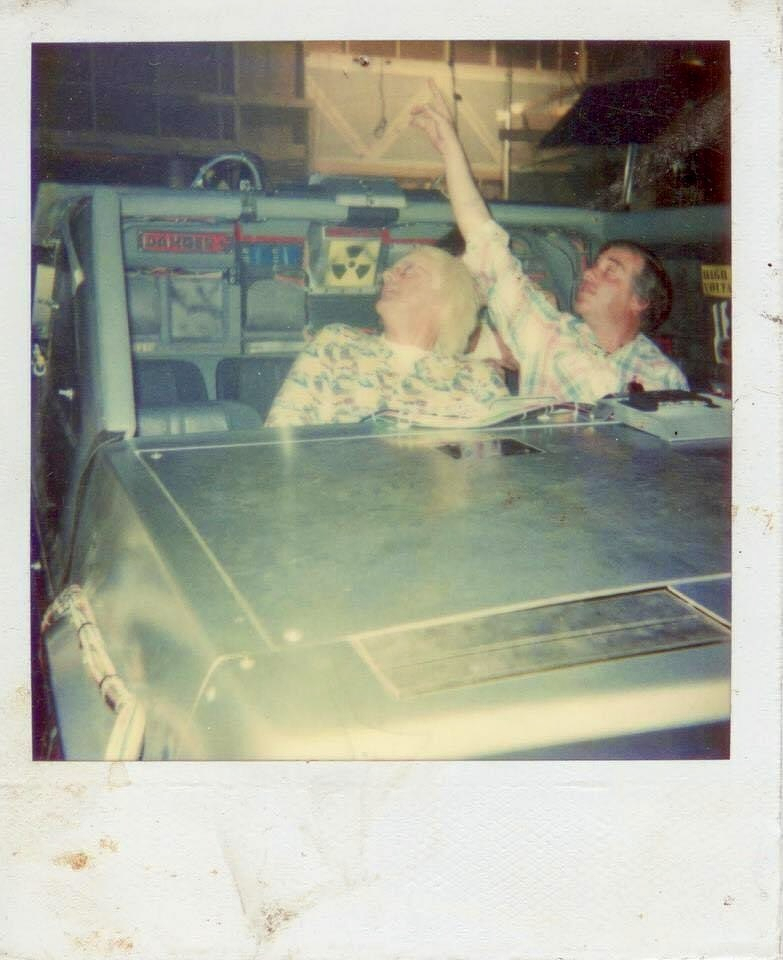
Years later, the work got bigger. That's Dad on the right, in the DeLorean with Christopher Lloyd in costume as Doc Brown, during filming of the pre-show footage for Back to the Future: The Ride. I took this picture myself.
Why I'm sharing this
There's a lot more in here: Yosemite, the early days of Universal Florida, Back to the Future, the movie stars whose dressing rooms the trams rolled past. But what I keep coming back to isn't the history. It's the sound of him. The dogs wandering through ("Casey, you want to go in the house?"). The easy back-and-forth with Jonathan. The way he lights up remembering people like Jay Stein and his old friend Cliff Walker. The way he keeps offering to do it again next week.
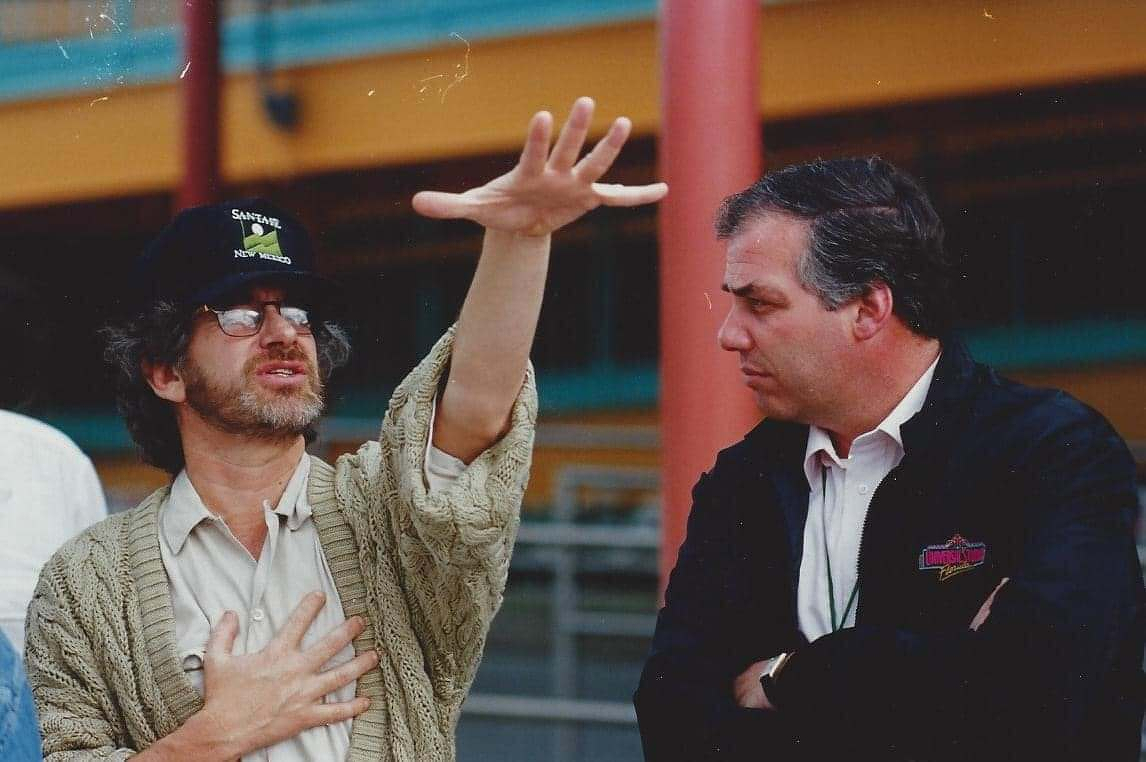
Dad (right) with Steven Spielberg at Universal Studios Florida.
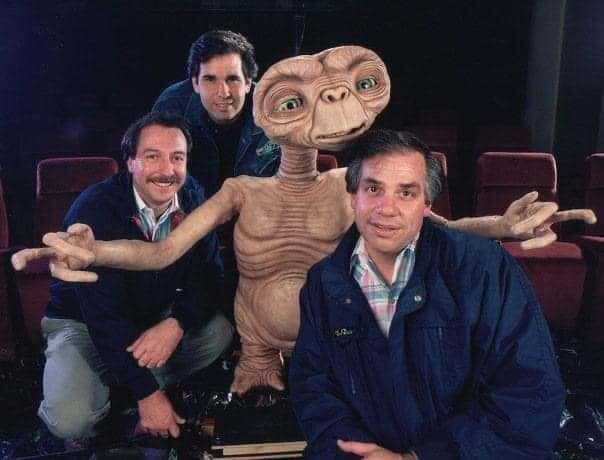
Dad (front right) with E.T., from the attraction he helped bring to the park.
My dad lived a remarkable, builder's life, and he told this story generously, to the son of his best friend, just months before he was gone. I'm endlessly grateful that Jonathan thought to ask, that he recorded it, and that he's given me his blessing to share the full audio.
Every other year, I've done the talking. This year, I'll step aside and let him take it from here.
Listen to the full two-hour conversation here: From Glamor Trams to Galactica: Terry Winnick on Building Universal Studios.
Happy Father's Day, Dad. Thanks for building things that outlasted you, and for leaving us this.
My deepest thanks to Jonathan Green for conducting and preserving this interview, and to Jonathan and his father Jerry for a friendship with my dad that made a conversation like this possible. Learn more about the history of the park at Inside Universal.